
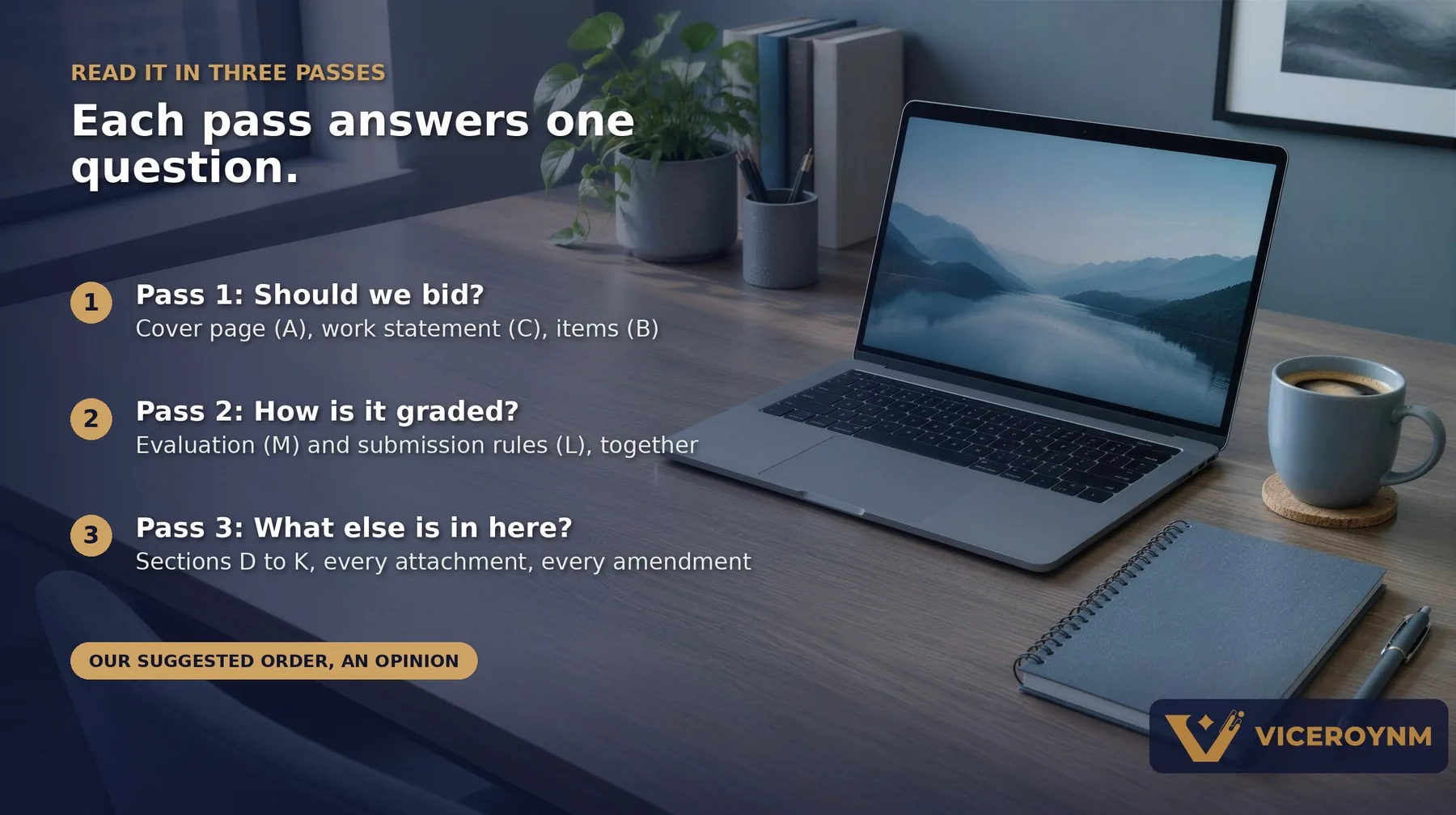
Read a federal solicitation three times, each time for a different question. On the first pass, decide whether to bid. On the second, learn how the government will evaluate the proposal and how you must submit it. On the third, read everything else, including the attachments and amendments.
This order is Viceroy NM’s practical method, not a rule. It is for the person who has just received a solicitation and a deadline: a founder, contracts lead, capture manager, or proposal writer new to federal work.
What is in a federal solicitation?
Many negotiated federal solicitations use the Uniform Contract Format in FAR 15.204-1, which organizes the document into 13 lettered sections, A through M. The format has exceptions, so always follow the actual solicitation in front of you. The Defense Logistics Agency’s guide to the Uniform Contract Format is a useful official companion.
| Section | What it holds | Why it matters |
|---|---|---|
| A | Solicitation or contract form | Identifies the procurement and usually shows the response deadline |
| B | Supplies or services and prices or costs | Your pricing must map to the stated line items |
| C | Description, specifications, or statement of work | Defines what the government needs |
| D to G | Packaging, inspection, delivery, and administration | Sets operational, acceptance, and performance details |
| H | Special contract requirements | Can carry requirements that are difficult to fix late |
| I | Contract clauses | Establishes terms that qualified reviewers should assess |
| J | List of attachments | Points to exhibits and documents that can carry binding requirements |
| K | Representations, certifications, and other offeror statements | Requires accurate, supportable answers |
| L | Instructions, conditions, and notices to offerors | Controls proposal organization and submission |
| M | Evaluation factors for award | Explains how the government will evaluate the offer |
The three passes
Pass 1: should we bid?
Read the cover form for the response date and time, the contracting office, and any set-aside information. Then read the work statement in Section C and the line items in Section B.
Ask four questions:
- Are we eligible to compete through the stated acquisition path?
- Can we deliver the required outcome within the schedule?
- Does the pricing structure match what we sell?
- Can we support every material claim we would need to make?
If the answer is no, stop. A fast no protects more time than a late no. Our guide to the six places a federal bid gets lost before anyone reads it covers the eligibility checks that belong before proposal drafting.
Pass 2: how are we graded, and how do we submit?
Read Section M for the evaluation factors and their relative importance. Then read Section L for proposal volumes, page limits, required format, submission method, and the deadline for questions.
The order matters because a proposal should spend its strongest evidence where the evaluation places the most weight. Under the FAR’s best-value continuum, the acquisition may use a tradeoff process or lowest-price technically acceptable process. The solicitation controls which method applies. For a deeper comparison, see From Lowest Price to Best Value.
Write the question deadline down immediately. If an instruction and an evaluation factor do not appear to align, ask the contracting officer through the solicitation’s stated process before that deadline.
Pass 3: what else is in here?
Read Sections D through K with the people qualified to evaluate them. Open every attachment. Search the complete package for cross-references, incorporated documents, special requirements, and amendment instructions. Confirm that the downloaded files are the current versions.
Read Sections L and M together
Section L tells you how to assemble and submit the proposal. Section M tells evaluators how to assess it. Treat them as one working pair.
Build a simple crosswalk:
- Each evaluation factor in Section M should point to the proposal section that answers it.
- Each required proposal volume in Section L should have an owner, a page limit, and a completion status.
- Staffing, schedule, technical approach, and price should tell the same operational story.
- Every stated requirement should be answered once in the correct place, then checked for consistency everywhere else.
If a polished section does not answer an evaluation factor or required instruction, it may consume pages without helping the proposal.
Worked example: a made-up solicitation
Illustrative dates, not Viceroy NM data. A solicitation is issued Monday, November 16, and proposals are due Tuesday, December 15 at 2:00 p.m. Eastern. Questions are due Tuesday, December 1 at 2:00 p.m. Eastern.
| Date | Step |
|---|---|
| Mon Nov 16 | Download the solicitation and every attachment |
| Wed Nov 18 | Finish Pass 1 and record the bid or no-bid decision |
| Mon Nov 23 | Finish Passes 2 and 3, build the checklist, and draft questions |
| Tue Dec 1, 2:00 p.m. ET | Submit questions through the stated channel |
| Tue Dec 8 | Complete drafts and confirm the latest amendments |
| Tue Dec 15, 2:00 p.m. ET | Submit the proposal using the stated method |
Suppose Section M says technical approach is more important than past performance, and past performance is more important than price. That hierarchy tells the team where the proposal needs its clearest evidence and strongest review. It does not make the lower-ranked factors optional.
Keep a requirements checklist
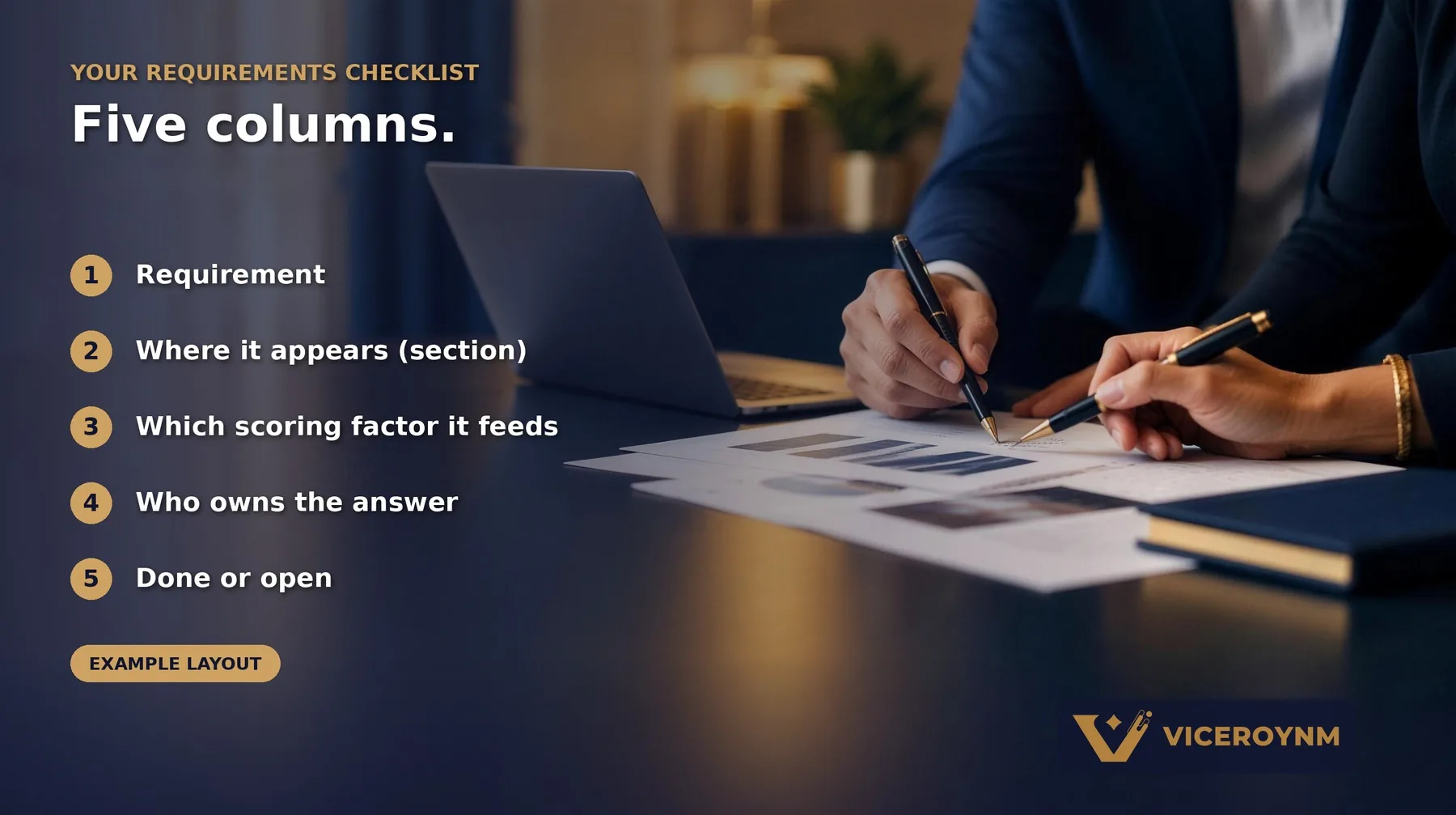
A checklist turns the solicitation from a long document into assigned, reviewable work. Start with five columns:
- Requirement
- Where it appears in the solicitation
- Which evaluation factor it supports
- Who owns the answer
- Done or open
Use exact section references, such as L.1 or C.3.2, rather than page numbers alone. Page numbers can change after an amendment, while the section reference is easier to trace.
The amendment step that gets missed
Solicitations can change after publication. An amendment may move the deadline, answer questions, replace an attachment, or revise clauses and instructions.
In April 2026, the National Nuclear Security Administration issued Amendment 0001 to solicitation 89233224RNA000008. It extended the submission date, posted answers, and revised multiple sections. Its Standard Form 30 also required offerors to acknowledge receipt before the deadline and warned that a late acknowledgment could result in rejection.
The same form lists three acknowledgment methods: return the completed amendment, acknowledge it on each submitted offer copy, or send a separate letter or electronic communication that identifies the solicitation and amendment. Follow the exact amendment and submission instructions that apply to your procurement.
Give one person responsibility for checking the official posting location, logging every amendment, updating the requirements checklist, and confirming acknowledgment before submission.
Three mistakes and the fix
Mistake 1: reading front to back
The team spends its best attention before reaching the sections that control evaluation and submission. Fix: use the three passes so the bid decision, evaluation method, and instructions are clear first.
Mistake 2: writing only to the work statement
The draft explains the work but does not map evidence to the stated evaluation factors. Fix: crosswalk every Section M factor to the Section L location where the answer belongs.
Mistake 3: treating amendments as an inbox task
No one owns the final check, so a changed date or attachment is missed. Fix: assign amendment control to one person and record every update in the checklist.
Where Viceroy NM fits
Viceroy NM is an Albuquerque-based federal contractor and a wholly owned subsidiary of Duskbridge. We represent Small Business status only and do not claim another socioeconomic set-aside status.
This article describes our suggested reading order. The solicitation, its amendments, the contracting officer, and qualified advisers control what applies to a specific acquisition.
Run this on a real solicitation this week
- Write down the closing date and time, set-aside, question deadline, and required deliverables.
- List the Section M factors in their stated order of importance.
- Record every Section L volume, page limit, format rule, and submission instruction.
- Build the five-column checklist from Sections L, M, and C.
- Check the official posting location for amendments and record how each must be acknowledged.
If you are a prime contractor or government buying team looking for a qualified small-business subcontractor, contact Viceroy NM’s government operations team to request our capability statement or start a teaming conversation.
This article is for general informational and educational purposes only. It is not legal, financial, or other professional advice. The applicable solicitation, amendments, contract, official record, contracting officer, and qualified adviser control. Details reviewed November 10, 2026. Next review scheduled for February 8, 2027.
Sources
Frequently asked
What are Sections L and M in a federal solicitation?
Under the Uniform Contract Format, Section L contains instructions, conditions, and notices to offerors, while Section M contains the evaluation factors for award. The actual solicitation controls and may use a different format.
Why should Sections L and M be read together?
Section L tells the team how and where to present the proposal, while Section M identifies how the government will evaluate it. Reading them together helps map every scored factor to a compliant response location.
Related reading
 Federal Procurement
Bid or No-Bid: Is This Solicitation Worth Answering?
Ask whether you can win, perform, earn a worthwhile return, and produce a compliant proposal before committing the team to write.
Federal ProcurementHow a Federal Invoice Gets Paid, and Why It Gets Sent Back
Federal payment depends on a proper invoice and a matching government acceptance record, so exact order data and early status checks prevent avoidable resets.