
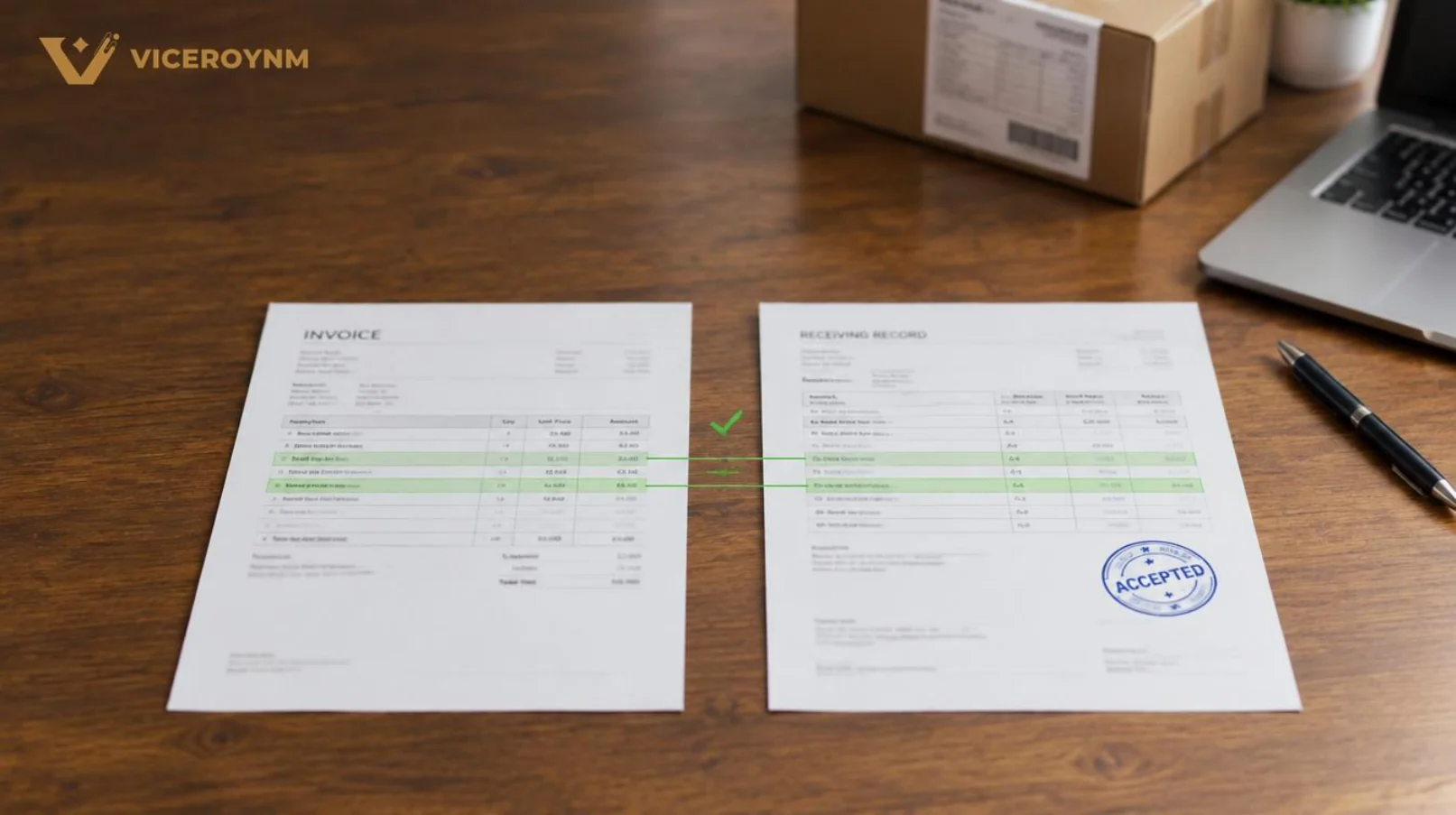
A federal invoice is not ready for payment merely because the supplier sent it. The government needs a proper invoice and a record that the supplies or services were received and accepted. When those records disagree, even a small mismatch can delay the payment clock.
This guide follows the invoice from delivery to payment, identifies common return reasons, shows what one wrong order number can cost in days, and ends with a six-step pre-submission checklist.
Why we are writing this
For a small supplier, payment timing affects cash flow. A returned invoice can add days to the standard payment period with little warning. Viceroy NM delivers physical products to federal customers, so this is our operating view from the supplier side.
This article is not legal or financial advice and does not replace the contract. The contract’s payment terms, submission instructions, and responsible government officials determine what applies.
The path from delivery to payment
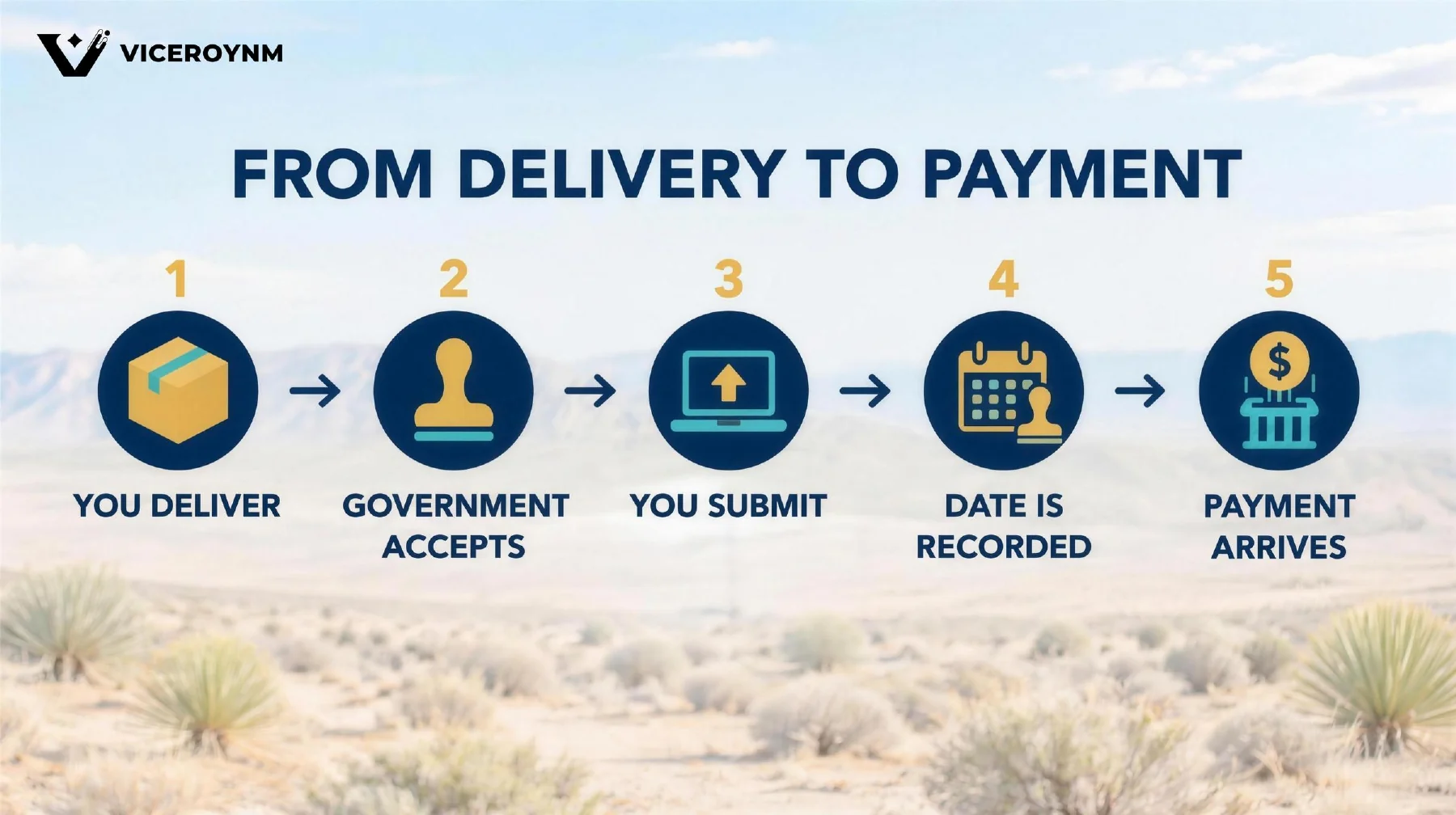
An invoice generally moves through five steps, and only some of them belong to the supplier.
- You deliver the products or complete the service. Keep the shipment, delivery, and completion records the contract requires.
- A government official accepts the work and records it. Under FAR 32.905, the receiving official should forward the receiving report or other payment documentation by the fifth working day after acceptance or approval unless another arrangement applies.
- You submit the invoice in the system named by the contract. For DoD contracts that require electronic submission, Wide Area Workflow, reached through PIEE, is the required electronic route described by the Defense Logistics Agency. Some civilian agencies use Treasury’s Invoice Processing Platform, which lets vendors submit invoices and check status. Other contracts name a different system.
- The billing office checks the invoice and records when it was received. That receipt date can control the payment calculation.
- The payment office releases payment. The payment route and banking information must match the current contract and registration records.
Our view: steps two and four belong to the government, but the supplier can still reduce uncertainty. Ask the receiving official to record acceptance promptly, use the exact submission route in the contract, and save the confirmation.
What a proper invoice carries
Federal payment depends on a proper invoice and satisfactory performance. Under the standard FAR 52.232-25 Prompt Payment clause, the designated billing office generally has seven days to return an improper invoice and explain the defect. The contract can contain different or additional requirements, so the clause in the awarded contract controls.
| What the invoice carries | A common slip to check |
|---|---|
| Contract number, order number, and line-item number | Contract number is present, but the order or line item is missing |
| Description, quantity, unit of measure, unit price, and extended price | Invoice quantity or unit differs from what was accepted |
| Invoice date and invoice number | A number is reused after a correction |
| Name and address for payment | Address differs from the contract record |
| Shipping and payment terms | Terms are omitted or copied from another order |
| Contact information for invoice problems | The billing office has no clear contact for a correction notice |
| Anything else required by the contract | Proof of shipment or another required attachment is missing |
Tax identification and bank information belong on the invoice only when the agency or contract requires them. Even when bank details are not printed on the invoice, the payment record still needs current information in the applicable registration system.
What one typo costs, in days
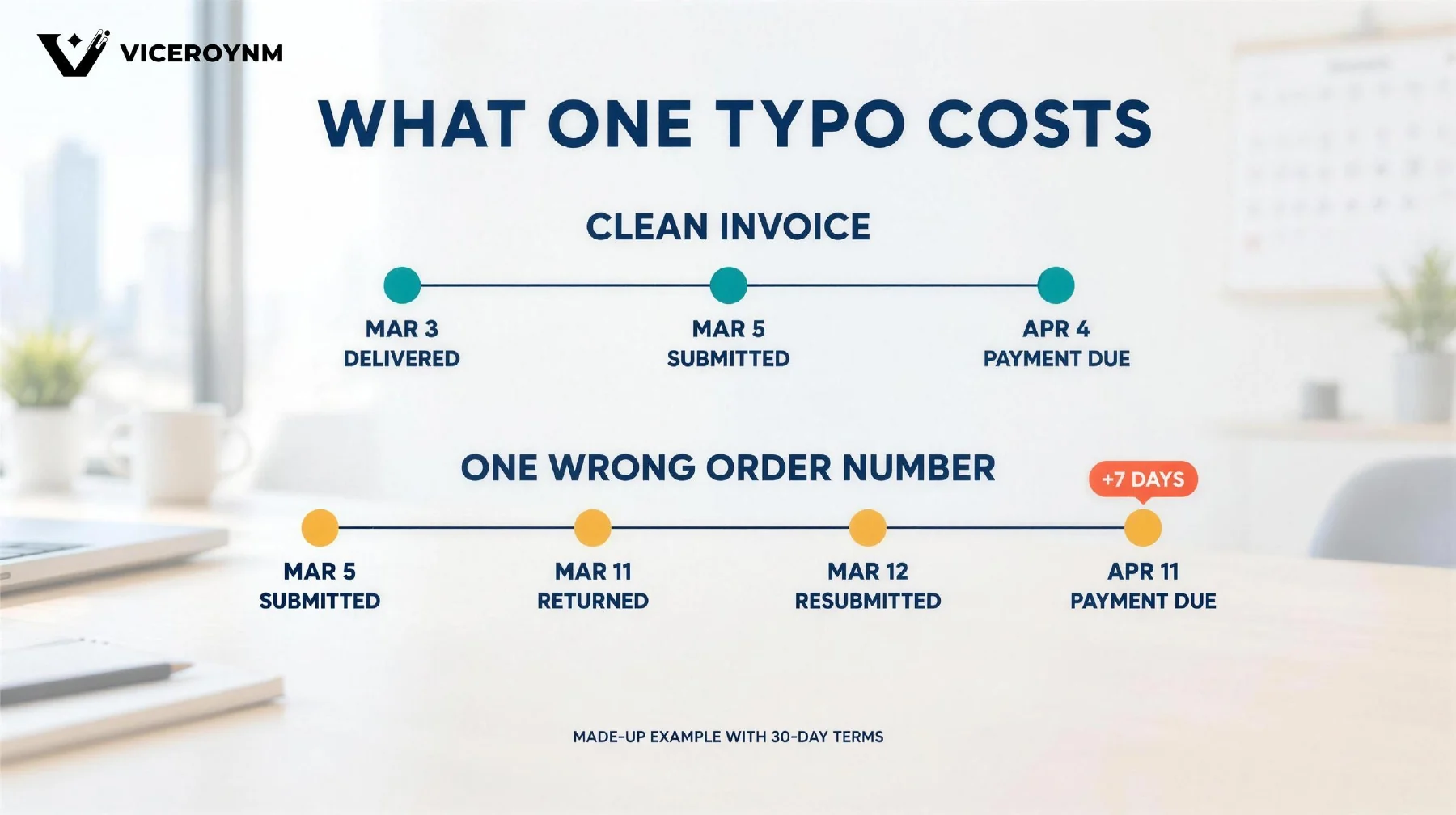
Consider a made-up example using the standard 30-day terms in FAR 52.232-25. Check the awarded contract because its terms may differ. Under the standard clause, payment is generally due 30 days after the billing office receives a proper invoice or 30 days after government acceptance, whichever event is later.
Clean invoice. Delivery occurs March 3. The government accepts the delivery March 5. The supplier submits a proper invoice March 5. The payment due date is April 4.
One wrong order number. The same invoice is submitted March 5 but carries the wrong order number. The billing office returns it March 11, and the supplier resubmits a corrected invoice March 12. The new payment due date is April 11.
Slow acceptance. The supplier submits a clean invoice March 5, but the government does not record acceptance until March 12. The later event controls, so the payment due date is again April 11.
In this example, one wrong number moves the due date by seven days, and the invoice sits for six days before the supplier receives the return notice.
Where we would look first when an invoice sits
If an invoice has been quiet for seven days, open the status screen and work through these four cases. Our rule of thumb is to check at day seven and send a written status note at day 14.
Status says not received
Confirm that the invoice was submitted through the system and office codes named in the contract. Use the saved submission confirmation.
Status says received but not accepted
Acceptance is the likely holdup. Contact the receiving official named in the contract rather than starting with the payment office.
Status says returned as improper
Correct each stated reason, resubmit through the required route, and record the new submission and receipt dates.
Status says accepted and past due
Ask the payment office to confirm the recorded invoice-receipt date and acceptance date. Lead with those dates. The standard prompt-payment clause provides for interest penalties in qualifying late-payment situations, but the contract and payment office determine the calculation.
Common questions
Does the clock start when I click submit?
Not necessarily. Under the standard clause, the relevant event is when the designated billing office receives a proper invoice, subject to the clause’s rules for an unannotated receipt date and the later government-acceptance date. Save the submission confirmation, but do not treat it as a substitute for the contract’s receipt rule.
Do I need my tax ID or bank details on the invoice?
Only when the agency or contract requires them on the invoice. Keep the corresponding registration and payment records current either way.
Who tells me if something is wrong?
Under FAR 52.232-25, the designated billing office generally sends a notice within seven days identifying why an invoice is improper. Monitor status rather than relying on the notice alone.
Is a returned invoice the same as a denied payment?
No. A return notice identifies information that must be corrected before the invoice can qualify as proper. Correct the listed defects, resubmit, and record the new receipt date.
Before you submit
- Open the contract or order and copy the identifying numbers directly from it.
- Match the quantity and unit of measure to what was delivered and accepted.
- Confirm the payment address and applicable registration information.
- Attach every item the contract requires, such as proof of shipment.
- Submit through the system named in the contract and save the confirmation.
- Put a status check on the calendar for seven days later.
When this does not apply
The standard rule is not universal. Construction contracts use the payment framework in FAR 52.232-27, including a standard 14-day payment period for progress payments. Certain food and agricultural products have shorter due dates, and cost-reimbursement or other contract types can use different invoice rules. A subcontractor is paid by the prime contractor under the subcontract’s terms, not directly under the prime contract’s government payment clause.
Read the actual payment clause before applying any timeline in this article.
Next step
Run the six checks above on the next invoice. If you are preparing for a first federal delivery or an invoice remains stuck after your documented follow-up, contact Viceroy NM with the public contract reference and status dates.
This article is for general informational and educational purposes only. It is not legal, financial, or other professional advice. The applicable contract, official record, and responsible government officials control. Details reviewed October 27, 2026.
Sources
Frequently asked
When does the standard federal invoice payment clock start?
Under the standard FAR 52.232-25 clause, the due date is generally tied to the later of the billing office's receipt of a proper invoice or government acceptance, subject to the exact contract terms and the clause's special rules.
What should a supplier do when an invoice is returned as improper?
Correct every reason listed in the return notice, resubmit through the contract's required system, and record the new submission and receipt dates because the corrected invoice may establish a new payment timeline.
Related reading
 Federal Procurement
Six Places a Federal Bid Gets Lost Before Anyone Reads It
Registration, size, vehicle access, performance evidence, teaming disclosure, and security posture can stop a federal bid before proposal quality is considered.
Federal ProcurementSelling to National Labs vs. Federal Agencies: What Changes
National laboratories buy through their operating contractors, changing where suppliers register, compete, contract, and challenge an award.