
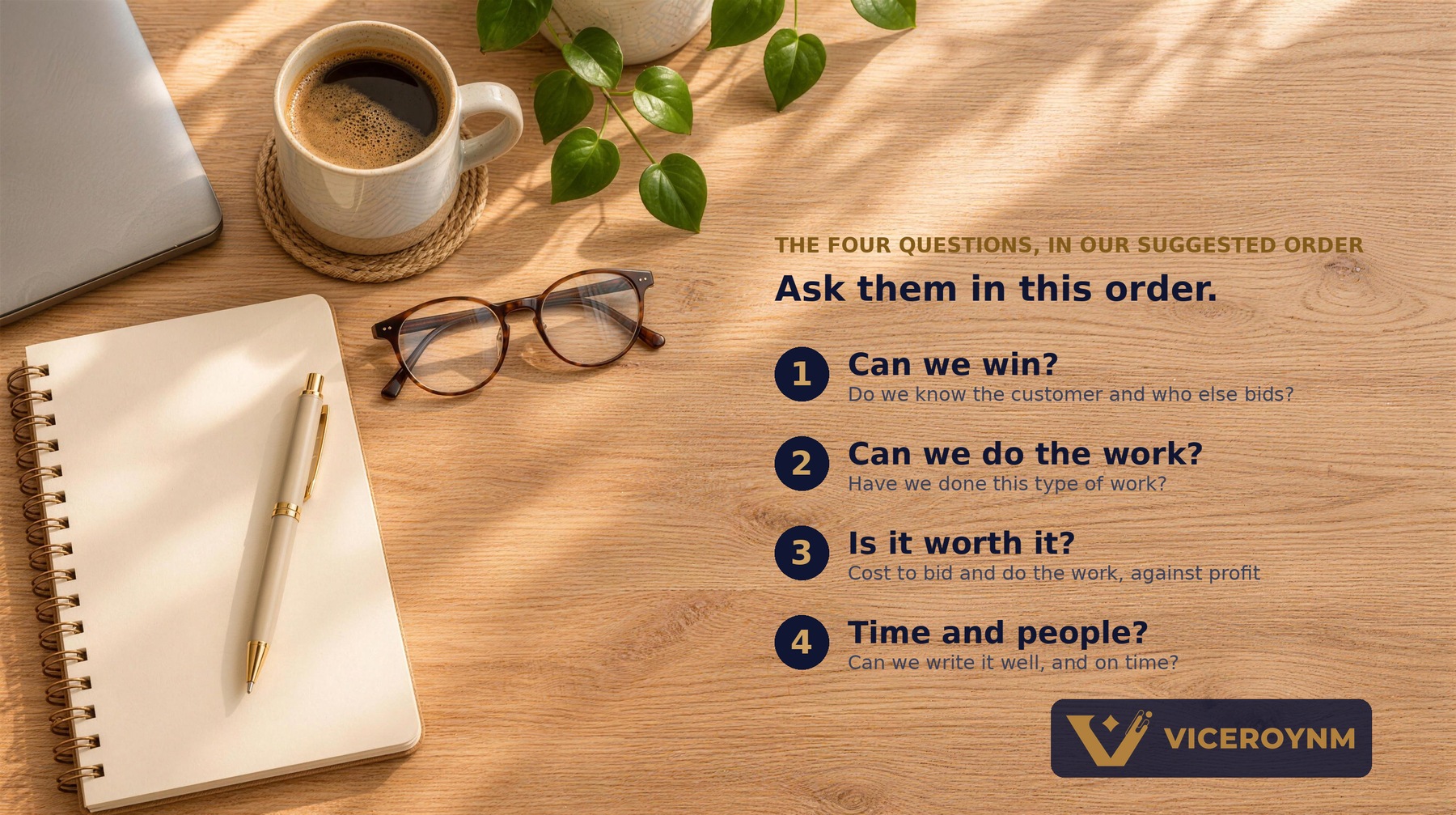
Before you write a word of a proposal, ask four questions: can we win, can we do the work, is it worth the cost, and do we have the time and people to do it well? If the honest answer to any one of them is no, a quick no-bid can be a good result rather than a failure.
Published guides agree on most of the questions but not on a single method. The four-question order here is Viceroy NM’s opinion, built from the practical advice in those guides.
Writing a federal proposal takes real hours from real people. When a team skips the decision and goes straight to writing, it can spend heavily and still lose. This guide is for the person who has a solicitation open and a deadline coming: a founder, contracts lead, capture manager, or proposal manager new to federal work.
Why a fast no is worth having
Washington Technology’s guide to the bid or no-bid decision says knowledge of the customer, competition, and your own company is the top criterion. The article also cautions against pursuing an opportunity merely because the contract value is high or the market is attractive.
GovCon Giants’ bid or no-bid guide makes the same practical point: decide early, assess the chance of winning realistically, and avoid spending proposal resources on a blind bid.
Neither source says that no-bidding is always right. The point is to decide on purpose, early, and before the work is spent.
The four questions
Here is the order we suggest. It is our opinion, and your team should adjust it to fit the opportunity.
| Question | What to ask | Where the guides point |
|---|---|---|
| 1. Can we win? | Do we know this customer and the work? Who else will bid? Is there an incumbent, and how satisfied is the agency with that contractor? | Washington Technology emphasizes customer and competitive knowledge. GovCon Giants lists a strong incumbent and no customer contact as caution signals. |
| 2. Can we do the work? | Have we performed this type of work before? Do we meet every material requirement, or are we stretching? | GovCon Giants recommends testing mandatory requirements, relevant past performance, available people, facilities, equipment, security needs, and subcontracting options. |
| 3. Is it worth it? | What will it cost to bid and perform? Is a realistic profit possible at a competitive price? What contract risks would we accept? | GovCon Giants recommends weighing expected profit and win probability against pursuit cost. |
| 4. Do we have time and people? | Can we write a complete, compliant proposal on time without undermining current work? | Washington Technology identifies proposal bandwidth and the available team as a deciding factor. |
If you have not checked the basics that can stop a bid before it is read, such as registration, size, and contract-vehicle eligibility, start with Six Places a Federal Bid Gets Lost Before Anyone Reads It. If you are still deciding how to review the document, see How to Read a Federal Solicitation in Three Passes.
Question 1: do we really know the customer?
In our view, this is the question teams skip most often. Bob Lohfeld, CEO of Lohfeld Consulting Group at the time of the Washington Technology article, identified understanding the customer, its requirements, and its objectives as the most important factor in the bid decision. GovCon Giants makes a similar point from the other direction: finding an opportunity only after the solicitation is posted and having no customer contact are caution signals.
Use a short test. Can you say, in two sentences, what problem this office is trying to solve and why it chose to buy this way? If you can only repeat the solicitation, you may not yet know the customer.
Signs an opportunity may favor someone else
GovCon Giants identifies a wired opportunity and a strong incumbent as reasons for caution. These are warning signs, not proof. A solicitation may also be detailed because the work is complicated.
Ask a question through the solicitation’s stated process before the deadline, and let the answer change your score. If the response does not resolve the concern, that is useful decision data too.
A worked example with made-up numbers
Illustrative numbers, not Viceroy NM data. Suppose a contract is worth $1,000,000 over its life and the expected profit margin is 8 percent, or $80,000 if you win. Suppose the proposal will require about $25,000 of staff time.
One simple test is to multiply expected profit by an honest probability of winning, then subtract the cost of bidding. GovCon Giants publishes this expected-value formula. We use a plain-language version here.
| Chance of winning | Profit times chance | Bid cost | Illustrative result |
|---|---|---|---|
| 20 percent | $16,000 | $25,000 | Minus $9,000: no-bid |
| 40 percent | $32,000 | $25,000 | Plus $7,000: bid |
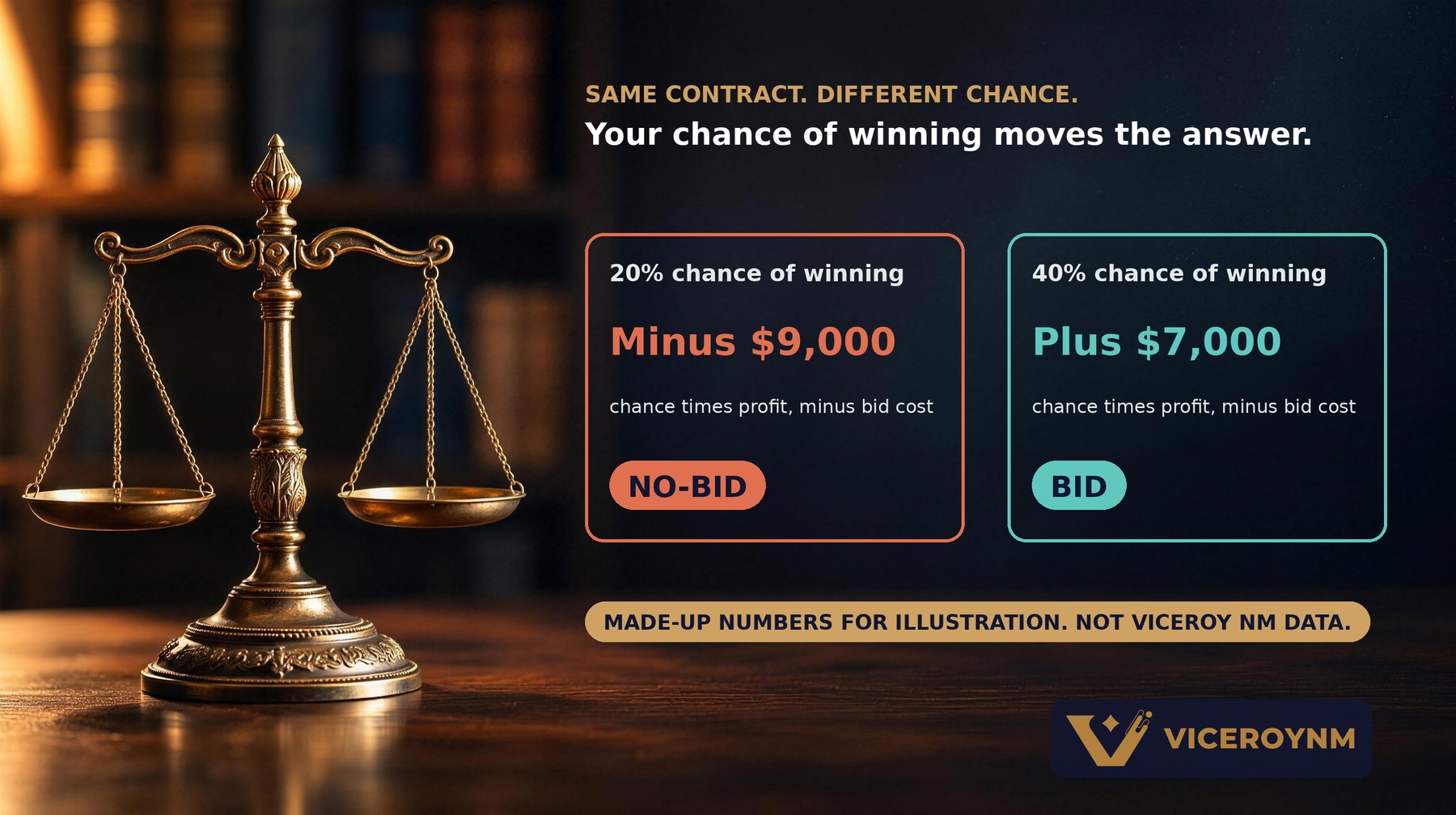
The example shows one thing: the chance of winning moved the answer, not the size of the contract. The chance of winning is still an estimate, so use a range and document the basis. A 40 percent estimate with no known customer contact is a reason to return to question 1.
The math is not the whole decision. It may not capture contract-type risk, cash-flow timing, or the consequences of a pricing mistake. On a firm-fixed-price contract, the contractor generally bears the cost of overruns within the agreed scope. The actual solicitation and contract terms control.
Set the rule before the solicitation arrives
The Washington Technology article advises companies to compete within their realistic weight class and describes bid decisions as a series of gates rather than one irreversible call. GovCon Giants and Coley GCS also describe a staged decision process, although they use different labels.
Our version has three parts:
- Write the team’s yes and no rules while no deadline is pressing.
- Make and record the initial call before proposal writing begins, including who decided and why.
- Check again at the question deadline, because what you learn may change the answer.
After the award, compare the original estimate with what happened. That feedback helps a team improve its future bid decisions.
When a no can become a yes as a subcontractor
If the team cannot responsibly pursue the work as the prime, a subcontracting role may still fit. That is a new decision, not an automatic fallback. Ask who will lead, what share of the work is yours, which requirements the team must satisfy together, and what the prime expects from you.
Three mistakes and the fix
Mistake 1: bidding because the contract is large
Size alone is a weak reason to bid. Fix: calculate expected value using a win probability you can explain, then test the contract and performance risks that the simple formula leaves out.
Mistake 2: deciding after half the proposal is written
By then, much of the cost is already spent and the team is vulnerable to sunk-cost thinking. Fix: decide before writing, then reconsider at a planned gate such as the question deadline.
Mistake 3: treating a no as a loss
A well-made no protects capacity for an opportunity the team can pursue credibly. Fix: keep a short decision record and evaluate the quality of the process, not just the number of bids submitted.
Where Viceroy NM fits
Viceroy NM is an Albuquerque-based federal contractor and a wholly owned subsidiary of Duskbridge. This article describes a general decision method, not how any particular bid was decided. Viceroy NM represents Small Business status only and does not claim another socioeconomic set-aside status.
Details reviewed November 18, 2026. Next review scheduled for February 10, 2027.
Run this on a real solicitation this week
- Pick one solicitation that is open or under consideration.
- Answer the four questions in one or two honest sentences each.
- Record the win probability as a range and estimate the bid cost.
- Decide before proposal writing begins, and note who decided and why.
- Set a reminder for the question deadline and review the decision again.
If you are a prime contractor or a government buying team looking for a qualified small-business subcontractor, contact Viceroy NM’s government operations team to request our capability statement or begin a teaming conversation.
This article is for general informational and educational purposes only. It is not legal, financial, or other professional advice. We make no guarantee that it is accurate, complete, or current. The applicable solicitation, amendments, contract, official record, contracting officer, and qualified advisers control.
Sources
Frequently asked
What are the four questions in a federal bid or no-bid decision?
Ask whether the team can win, can perform the work, can justify the pursuit and performance costs, and has enough time and qualified people to submit a complete proposal.
How can a contractor estimate whether a bid is worth pursuing?
One starting point is expected profit multiplied by an honest probability of winning, minus pursuit cost. The team should also test contract terms, cash flow, delivery risk, and strategic fit because the simple formula does not capture them.
Related reading
 Federal Procurement
How to Read a Federal Solicitation in Three Passes
Review a federal solicitation in three passes: decide whether to bid, map evaluation factors to instructions, then check every remaining section, attachment, and amendment.
Federal ProcurementHow a Federal Invoice Gets Paid, and Why It Gets Sent Back
Federal payment depends on a proper invoice and a matching government acceptance record, so exact order data and early status checks prevent avoidable resets.