

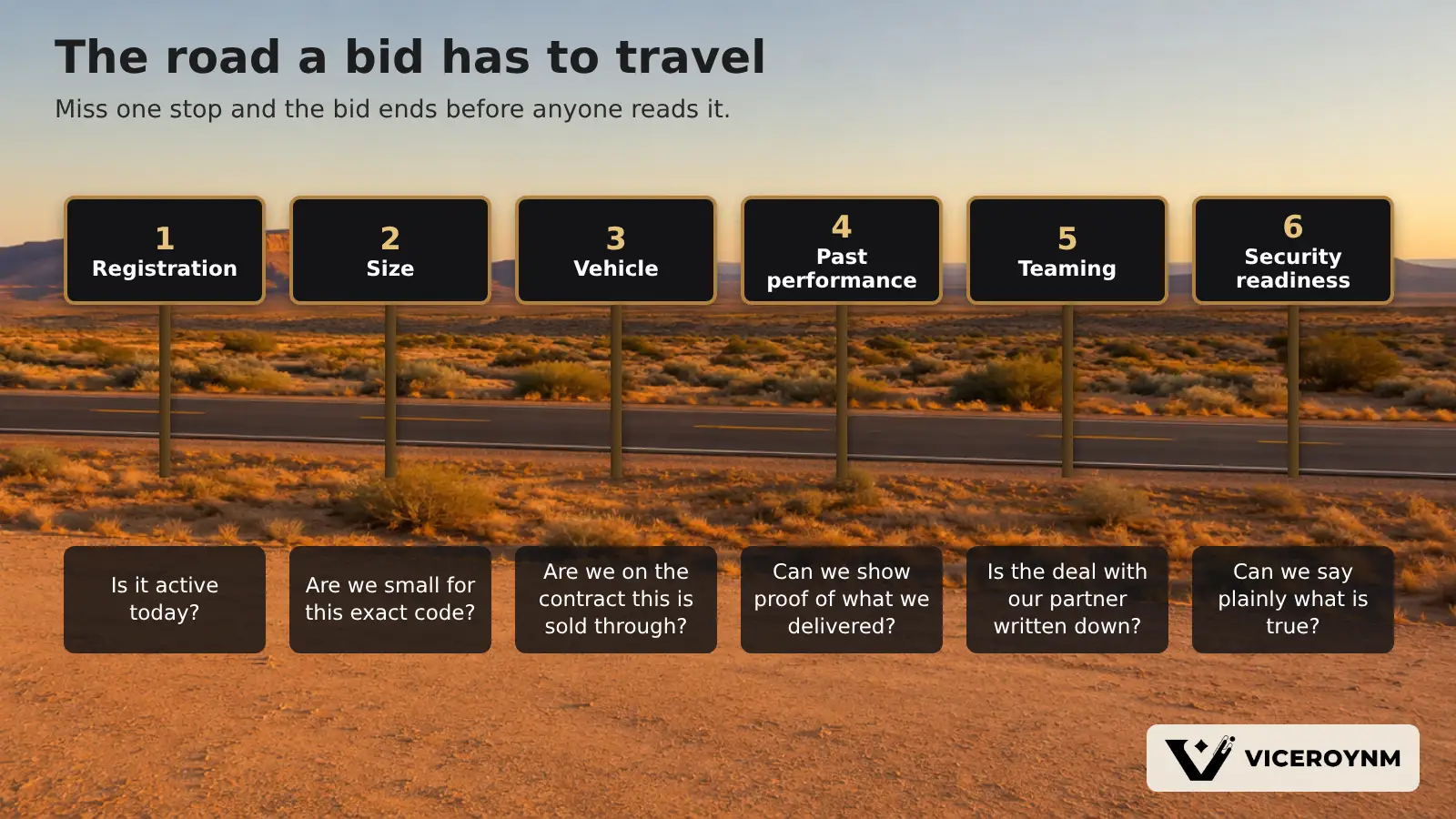
A federal bid can leave the running before anyone reads the proposal. The cause is often outside the narrative itself: an inactive registration, a size claim that does not fit the solicitation, a contract vehicle the bidder does not hold, thin past-performance evidence, an undisclosed teaming arrangement, or a security-readiness gap.
This guide walks through all six, shows the mistake that wastes the most writing time, and ends with six questions to answer before proposal work begins.
Why we are writing this
This is Viceroy NM’s operating view as a small federal contractor, not legal advice. Rules and solicitation terms change, and the contracting officer and qualified counsel determine what applies to a specific acquisition. Our goal is to show where bids can quietly stop so each issue can be checked early.
One: your registration is not active
For most federal offers and quotations, FAR 4.1102 requires the offeror to be registered in SAM when the offer or quotation is submitted, subject to the exceptions listed in the rule. A renewal that lapses, or a submitted update that has not yet become active, can therefore stop an otherwise competitive response.
Viceroy NM monitors the registrations and portal records used for its opportunities, including SAM.gov, Unison Marketplace, and Bonfire. Our practice is to place renewal dates on a shared calendar with a 60-day warning, then open the required record on day one of a bid and again on submission day. Treat registration verification as a bid step, not a one-time administrative task.
Two: your size claim does not fit the work
Small-business eligibility is tied to the NAICS code and size standard assigned to the solicitation, not simply to the company’s general identity. The same company can qualify as small for one acquisition and not for another. The SBA explains that contracting officers assign a NAICS code and businesses must meet the corresponding size standard.
Viceroy NM’s current public NAICS record lists 17 codes: 11 for physical-product procurement and 6 for software and technology services. Viceroy NM represents Small Business status only and does not represent an additional socioeconomic set-aside status.
Check size against the code on each solicitation rather than relying on a previous bid. If ownership, affiliates, revenue, staffing, or another size factor changed, confirm the current answer before submitting.
Three: you are not on the vehicle
Some opportunities are competed only among holders of a named contract vehicle. If a solicitation is limited to that vehicle, a company that does not hold it cannot respond as a prime through that path, regardless of proposal quality.
Keep a one-page record of every vehicle or agreement that is currently supported by award documentation, including its ordering scope and the date the record was checked. Viceroy NM’s public contract-vehicle page does not represent a GSA MAS, IDIQ prime contract, or federal BPA without current award documentation. If an opportunity names a vehicle that is not on the verified list, decide on day one whether a valid teaming path exists or whether to pass.
Four: your past-performance record is thin
Evaluators consider the recency, relevance, quality, and source of past performance under the evaluation approach in the solicitation. Having a limited record is not automatically disqualifying, but it can leave the evaluator with less evidence than competing offerors provide.
Viceroy NM’s documented federal past performance covers physical-product fulfillment. The public record includes repeat orders from one customer, reports every awarded contract fulfilled, and represents no federal software or AI past performance.
Keep delivery evidence as the work happens. A practical file for each order includes the order, delivery and acceptance evidence, and any written customer evaluation. Save it while the facts are fresh, and claim only what the supporting record proves.
Five: your teaming was not disclosed
When companies use a contractor team arrangement, FAR 9.603 says the arrangement must be identified and the company relationships fully disclosed in the offer, or disclosed before a later arrangement becomes effective.
Do not leave the arrangement as a handshake. Before submission, write down who leads, who performs each part of the work, and how responsibility is divided. Have both parties review the offer language and confirm that it matches the solicitation and the current agreement.
Six: your security readiness takes longer than the bid
Security requirements vary by agency, data type, system boundary, and contract clause. Readiness work can take longer than the response window, and an unsupported certification claim creates more risk than a candid limitation.
Viceroy NM describes alignment to or work toward the NIST AI Risk Management Framework, OWASP, CMMC, and FedRAMP. It does not represent CMMC certification, FedRAMP authorization, an ATO, an FCL, personnel clearances, a FedRAMP sponsor, an SPRS score, or SOC 2. The current boundary is stated on the security page.
Review the company’s status before a solicitation arrives. Write two plain statements: what the organization is aligned to or working toward, and what it currently holds. Do not combine those statements or overstate either one.
The six at a glance
| # | Place | What goes wrong | When to check |
|---|---|---|---|
| 1 | Registration | Lapsed or still pending | Day one and submission day |
| 2 | Size | Wrong NAICS code or changed company facts | Day one of each bid |
| 3 | Vehicle | Bidder is not an eligible holder | Day one: team or pass |
| 4 | Past performance | Evidence is thin or undocumented | As each delivery closes |
| 5 | Teaming | Arrangement is not stated in the offer | Before proposal review and submission |
| 6 | Security readiness | Work starts after the solicitation arrives | On a recurring internal review cycle |
Why early losses are hard to see
Many contractors never receive a detailed explanation for an unsuccessful bid. A protest is a formal challenge, but only a small share of procurements become protests. In fiscal year 2025, the U.S. Government Accountability Office reported 1,617 protests filed, 380 merit decisions, and a 14 percent sustain rate among those merit decisions.
That does not measure all unsuccessful bids. It shows why a supplier should not expect a protest record to reveal every early eligibility or process problem.
Mistake and fix: writing first, checking later
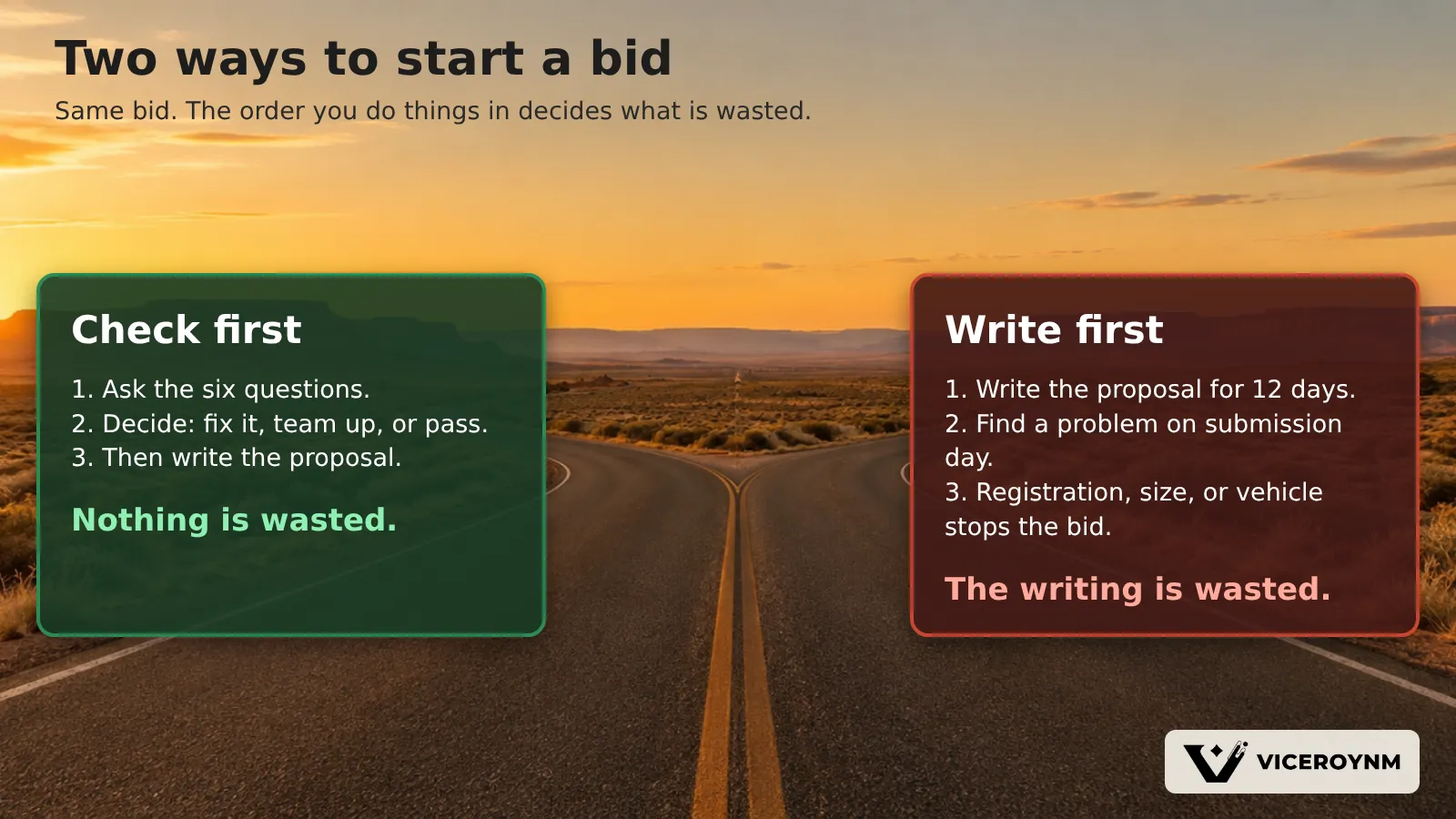
Mistake: a team spends two or three weeks writing, then discovers on submission day that a registration lapsed or the named vehicle is unavailable.
Fix: run the six checks on day one and record the answer to each. If an answer is no or unclear, decide immediately whether to fix it, establish a compliant teaming path, or pass.
How Viceroy NM works
Viceroy NM is an Albuquerque-based federal contractor and a subsidiary of Duskbridge. Its documented federal past performance covers physical-product fulfillment. Because proposal time is limited, a no-bid decision made on day one costs far less than the same decision made after the draft is complete.
The six checks above belong at the start of every bid, including ours.
Six questions before you write
- Is our required registration active today, and when does it renew?
- Are we small under the NAICS code assigned to this solicitation?
- Are we eligible to bid through the named vehicle, or is there a documented teaming path?
- Can we show current, relevant, and supportable past-performance evidence?
- If we team, is the arrangement written down and disclosed correctly in the offer?
- What can we truthfully say about our security readiness and current credentials?
Next step
If you want a second set of eyes on a bid decision, contact Viceroy NM’s government operations team before the writing window closes.
This article is for general informational and educational purposes only. It is not legal, financial, or other professional advice. The applicable solicitation, contract, official record, contracting officer, and qualified adviser control. Details reviewed October 27, 2026.
Sources
- FAR 4.1102, System for Award Management registration policy
- U.S. Small Business Administration, guidance for federal contracting officials
- FAR 9.603, contractor team-arrangement policy
- U.S. GAO, Bid Protest Annual Report to Congress for Fiscal Year 2025
- Viceroy NM, NAICS codes, contract-vehicle status, past performance, and security boundary
Frequently asked
What should a federal bid team check before writing the proposal?
Check the required registration, NAICS-based size status, contract-vehicle eligibility, relevant past-performance evidence, teaming disclosure, and the accuracy of every security-readiness statement.
Does being a small business make a company small for every federal solicitation?
No. Small-business eligibility is evaluated against the NAICS code and corresponding SBA size standard assigned to the specific solicitation, along with the company's current facts and affiliates.
Related reading
 Federal Procurement
How a Federal Invoice Gets Paid, and Why It Gets Sent Back
Federal payment depends on a proper invoice and a matching government acceptance record, so exact order data and early status checks prevent avoidable resets.
Federal ProcurementSelling to National Labs vs. Federal Agencies: What Changes
National laboratories buy through their operating contractors, changing where suppliers register, compete, contract, and challenge an award.